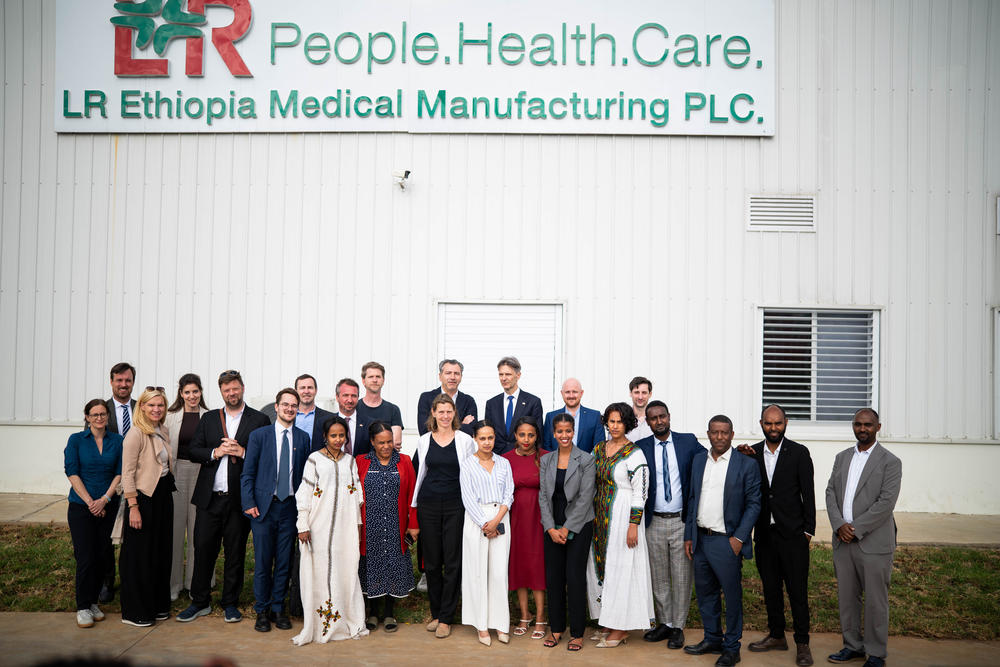
On April 19, 2026, a delegation of approximately 30 people from Austria visited LR Ethiopia Medical Manufacturing PLC (L&R Ethiopia) in Addis Ababa, Ethiopia. L&R Ethiopia is a subsidiary of the internationally active medical device company Lohmann & Rauscher (L&R), which has roots in Austria and Germany. The delegation was led by Dr. Peter Huber, Head of Section at the Federal Ministry for European and International Affairs (BMEIA), and the Austrian Ambassador to Ethiopia, Dr. Simone Knapp. Representatives from the APA, the Austrian media outlets “Die Presse” and “Der Standard” as well as a business delegation comprising representatives of Austrian companies were also part of the delegation.L&R Ethiopia is the first production facility established by L&R in Africa. Thomas Menitz, CEO and COO of the L&R Group, guided the delegation through the production facilities and provided insight into the journey so far and the motivations behind L&R’s investment in Ethiopia.
The L&R Group was founded in 1998 through the merger of the German company Lohmann and the Austrian company Rauscher, though its roots, through its predecessor companies, date back to the 19th century. Today, L&R is a global player as one of the leading developers, manufacturers, and suppliers of medical and hygiene products and services in the fields of wound care, compression therapy, and OR, with 60 group holdings and subsidiaries and approximately 6,200 employees.
Investment in Ethiopia
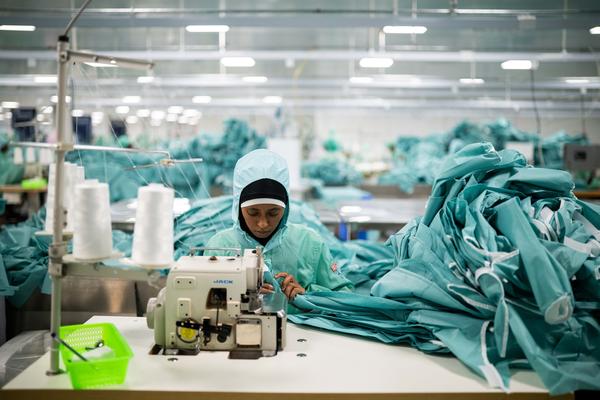
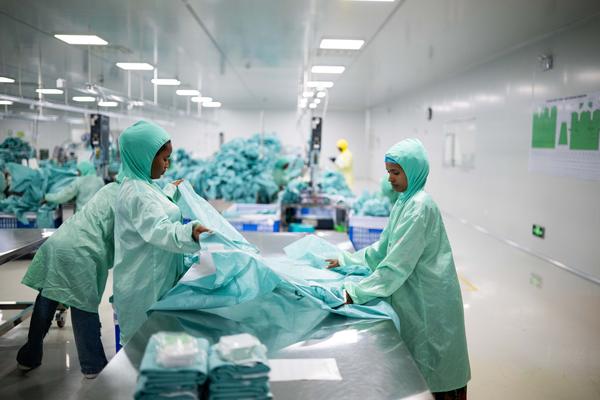
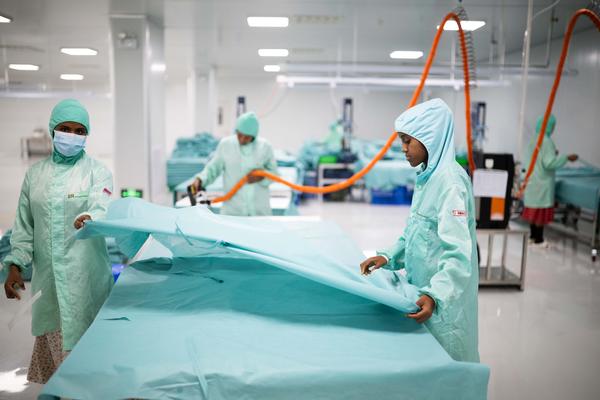
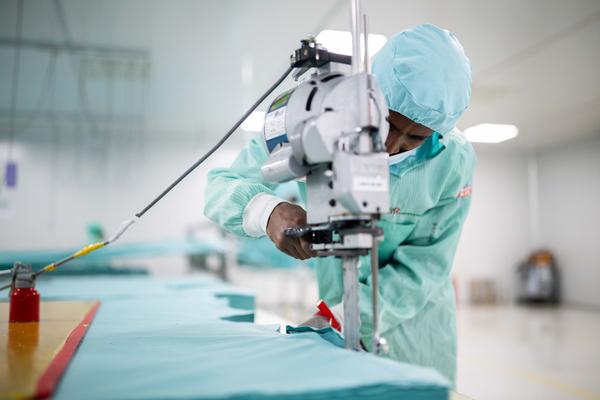
L&R Ethiopia was opened in fall of 2024 and now has around 300 employees. Sentinex®PRO surgical gowns (SMMS) are produced in a cleanroom at the 15,000-square-meter facility in the Bole Lemi industrial zone on the outskirts of Addis Ababa. The disposable surgical gowns are worn by healthcare personnel during surgical procedures for reasons of infection preventionand hygiene. The medical devices produced in Ethiopia are supplied to a wide range of customers in healthcare facilities across Europe. The manufacturing company is led by a five-member management team headed by General Manager Solomon Nekatibeb.
What motivated L&R to invest in Ethiopia? For many years, L&R has been pursuing an ambitious growth strategy. This strategy encompasses not only growth in terms of revenue and sales volume, but also a clear commitment to in-house development (R&D) and, above all, to its own production facilities and expertise. Today, L&R has over 18 production sites worldwide - twelve of which are in Europe (Austria, Germany, the Czech Republic, Switzerland, France, the United Kingdom, the Netherlands, and Portugal), two in North America (the U.S. and Mexico), two in Asia, and one each in South America (Brazil) and Africa (Ethiopia).
L&R’s primary goal is to always provide the best possible supply to customers and healthcare systems. To this end, L&R pursues a “multiple-sourcing” and “near-shoring” strategy - that is, it relies on multiple production sites, a wide range of suppliers, and production sites close to Europe to ensure the highest possible supply security.
Copyright (all pictures): Michael Gruber, on behalf of BMEIA
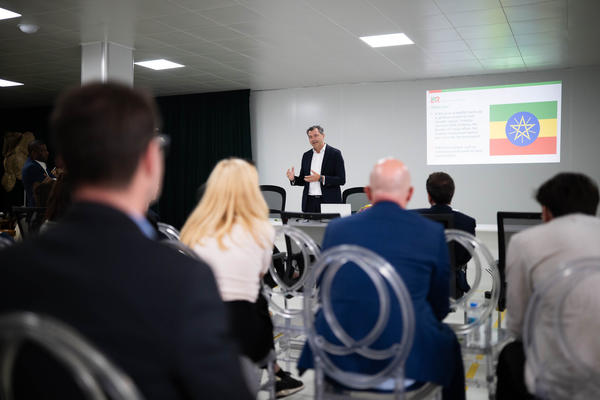
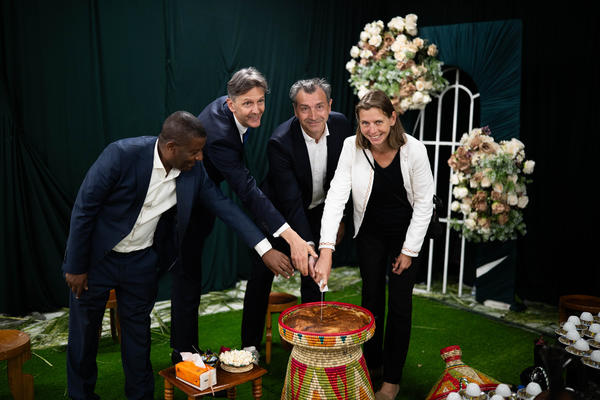
Thomas Menitz, CEO and COO of L&R: “Emerging from the greatest pandemic of recent decades, we have felt how the supply security that has always been our focus has taken on a whole new significance. Over three years of the COVID-19 pandemic, as well as the political and military crises and wars of recent years, which have negatively impacted transport routes from the Far East, have presented us -and our competitors - with major challenges and supply bottlenecks. Additional production sites near Europe, such as in Ethiopia, are part of the solution here to make us more crisis-resilient and thus act entirely in the best interests of our customers. Our top priority is to ensure the highest possible supply security for our customers.”
In addition, as a family-owned company, L&R increasingly wants to - and does - assume social responsibility in the countries of the Global South. Thomas Menitz adds: “The refugee crisis in 2015 and beyond has shown that we must create solutions not only in Europe but also, for example, in Africa. Industry can also make a contribution here. Our production facility in Ethiopia has already provided jobs for 300 people, enabling them to support themselves and their families. We are proud to actively contribute to sustainable social development through our subsidiary in Addis Ababa!”
Prior to 2024, disposable surgical gowns were produced at L&R’s own plant in Xishui, China; today, a portion is manufactured in Ethiopia. The relocation of part of the production was expected to improve competitiveness and provide greater flexibility in managing potential bottlenecks in production or transport capacities from the Far East. The proximity to the African market and the growth prospects in Ethiopia also motivated L&R to invest.
Thomas Menitz, CEO and COO of L&R: “In addition to the reasons already mentioned,our investment in Ethiopia and many other locations is part of our growth strategy to expand our global presence in the medical device market, reduce our dependence on China, and strengthen the medical device industry in Ethiopia. We saw and continue to see many interesting opportunities and avenues for development in Ethiopia.”
Now, nearly two years after the start of production in Ethiopia, what is L&R’s initial assessment?
Thomas Menitz: “It’s a mixed picture. I think our local team and our international consulting colleagues are doing an excellent job here - and I’d like to take this opportunity to thank them very much for that. I’d also like to extend my heartfelt thanks to the staff at the Austrian Embassy, the Ministry of Foreign Affairs, and the Austrian Development Agency for their support. Without their active contribution, we wouldn’t be standing here today. However, our expectations have also been somewhat dampened, and we are facing several challenges, including high logistics costs, poor and limited transport connections to Europe, and the extensive bureaucracy in the country, which leads to long processing times, for example, in customs clearance.”
Contrary to the original promises, the company receives only limited concrete support for foreign export-oriented businesses. Furthermore, they face high tariffs and a lack of subsidies (compared to the extensive funding opportunities available in China). Even basic operating supplies are either unavailable or significantly more expensive compared to China and Europe.
Thomas Menitz: “Even though -or precisely because - getting established here hasn’t always been easy and we are now facing the challenges mentioned, we have gone through an enormous learning curve. I am proud of the work the team has already done and continues to do. We remain convinced of the value of this investment - because the last few weeks in particular have shown that our near-shoring and multiple-sources strategy is more important than ever. One thing is certain: As a key player in healthcare in Austria, Europe, Africa, and worldwide, we take our responsibility to provide the best possible care for healthcare systems very, very seriously. And this is also evident in concrete terms here in Addis Ababa.”
Training and Collaborations
One of the most important offerings for employees at L&R is training through the company’s in-house training institution, the L&R Academy. The corporate group offers more than 500 multilingual training sessions and workshops per year, in both in-person and online formats. These learning programs include product workshops, language courses, training on AI and PC applications, soft skills, and much more, and some are also certified. Employees at L&R Ethiopia also completed intensive onboarding and training at the start of their employment.
Last but not least, L&R customers - that is, healthcare professionals - are also an important target group for L&R’s continuing education offerings. These are conducted either directly by L&R or in cooperation with partners. Globally, these include the United Nations (UN), the World Health Organization (WHO), various European and Austrian educational institutions, and in the Middle East and Africa, the “National Agency for Health Evaluation and Accreditation, Turkey” (INEAS), the “Islamic World Educational, Scientific and Cultural Organization” (ICESCO), the “Arab League Educational, Cultural and Scientific Organization” (ALECSO), and “Pan-African Women in Health” (PAWH).L&R offers numerous training opportunities, particularly in the field of wound care for acute and, above all, chronic wounds—one of the main areas of application for L&R products (wound dressings, compression bandages, and systems).
Insights into production at L&R Ethiopia
Copyright: Michael Gruber, on behalf of BMEIA